

This article investigates how the data center market generates economic wealth from three distinct and complementary layers. The first covers the direct impacts of construction, jobs generated in the work, acquisition of materials, engineering contracting, earthworks, electrical infrastructure, fiber connection and collection of local taxes. The second brings together the indirect and induced effects, which arise from the activation of suppliers, maintenance services, security, facilities, telecommunications, hotels, food and the circulation of income in regional economies. The third and most significant, in the long term, concerns the systemic value of cloud computing: productivity gains, IT cost reduction, acceleration of innovation, emergence of startups, business scalability and attraction of new investments. To make the comparison between projects of different scales objective and replicable, the study proposes the IT MW as the central unit of analysis. The results indicate that the construction of data centers produces relevant local wealth in the short and medium term, but the economic effect of greater magnitude and reach, in the long term, comes from the intensive use of cloud services and the digitalization that they make possible. In normalized values, each MW of IT can be associated with construction investments of between US$7 million and US$15 million, 60 to 120 direct job-years in the implementation phase, and a cloud-enabled economic value of between US$15 million and US$60 million per year.


- ABDC
- Iniciativas
- GT Governo
- GT Regulação
- GT ReData
- GT Energia
- White Paper
- GT Res. 780/2025 Anatel
Iniciativas
Educação
Incentivo e Relações Governamentais
Pesquisa e Orientação
Network e Trocas
- Associados
- Guia de soluções de associados
- Noticias
Notícias

ABDC – Brazilian Data Center Association will be present at GLOBAL DATA CENTER & CLOUD EXPO CANADA (GDCC) – Most Influential Digital Infrastructure Event ) 2026, which will be held on October 20th and 21st, 2026, in Canada.
A ABDC – Associação Brasileira de Data Center estará presente na GLOBAL DATA CENTRE & CLOUD EXPO CANADA (GDCC) – Most Influential Digital Infrastructure Event ) 2026, que será realizada… - Treinamentos
Treinamentos

ABDC In-person Training – Data Center Design, Project and Construction
02/07/2026 8:00 am
- Eventos
Eventos
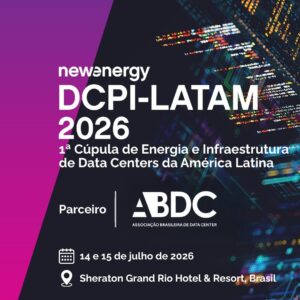
NEWENERGY – DCPI-LATAM 2026 – 1st Energy and Infrastructure Summit for Data Centers in Latin America
14/07/2026 12:00 am

- Português
- English
- Mapa Data Center