



The evolution of information technology can be interpreted as a sequence of waves of industrialization of computing capacity. Each wave is born out of a limitation of the previous one, reaches market scale when it finds technical standardization, a supplier ecosystem and clear economic value, reaches maturity when it becomes predictable and widely adopted, and enters relative decline when it ceases to be the dominant platform for new cargo. Decline, in this article, does not mean disappearance. Mainframes, PCs, local networks and own data centers remain relevant. What changes is the center of gravity of investment, innovation and market growth. The sequence analyzed is: mainframe, microprocessors and PC/x86, local networks and client-server, commercial Internet, virtualization, public cloud, modern colocation, local zones and edge, hyperscale, generative AI and AI factories. The executive view is that IT is no longer just administrative support but has become productive infrastructure. This article devotes expanded attention to the cloud and data centers because the cloud is not an abstract phenomenon. It depends on buildings, power, cooling, connectivity, supply chain, 24x7 operation and long-term contracts. The rise of hyperscalers and AIfactories makes this materiality even more explicit. The central thesis is that AI factories represent the new frontier of digital infrastructure: facilities and platforms that transform data, energy, chips, models and engineering into intelligence. This transformation repositions data centers as assets comparable to factories, refineries, ports, electrical grids and other critical infrastructures of the contemporary economy.


- ABDC
- Iniciativas
- GT Governo
- GT Regulação
- GT ReData
- GT Energia
- White Paper
- GT Res. 780/2025 Anatel
Iniciativas
Educação
Incentivo e Relações Governamentais
Pesquisa e Orientação
Network e Trocas
- Associados
- Guia de soluções de associados
- Noticias
Notícias

Futurecom – ABDC20
🇧🇷🚀ABDC – Associação Brasileira de Data Center apoia institucionalmente a Futurecom 2026 A ABDC – Associação Brasileira de Data Center apoia institucionalmente a Futurecom 2026, um dos principais encontros da… - Treinamentos
Treinamentos
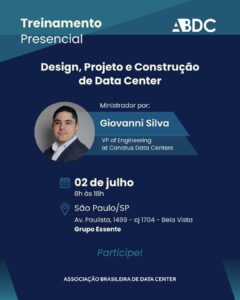
ABDC In-person Training – Data Center Design, Project and Construction
02/07/2026 8:00 am
- Eventos
- Português
- English
- Mapa Data Center